
Have you ever wondered why you become anxious when someone takes a little longer to reply? Or why you sometimes pull away when a relationship starts to feel more serious? Perhaps you find it relatively easy to trust people, communicate what you need and feel comfortable both together and apart.
Some of these patterns can be understood through attachment theory.
Our attachment style describes some of the ways we tend to connect with other people, particularly when relationships make us feel vulnerable, uncertain or emotionally close. These patterns can influence how we communicate, respond to conflict, ask for reassurance and cope with intimacy.
Attachment styles are not diagnoses or fixed personality types. Think of them instead as patterns that may have developed through our experiences of relationships. You might recognise yourself strongly in one attachment style, see elements of yourself across several, or notice that you behave differently in different relationships.
Understanding these patterns isn't about putting yourself into a box. It's about becoming more aware of what happens for you in relationships – and recognising that these patterns can change.
What Is Attachment Theory?
Attachment theory was originally developed by psychiatrist John Bowlby, who explored the importance of the bonds children develop with their earliest caregivers.
The basic idea is that our early relationships can help shape what we learn about closeness, trust and emotional safety.
When care is generally warm, responsive and consistent, a child may learn that other people can be relied upon and that their needs are safe to express. When care is inconsistent, unavailable, frightening or unpredictable, different ways of maintaining connection or protecting ourselves may develop.
These early experiences don't determine every relationship we'll have as adults. However, they can contribute to patterns that continue later in life.
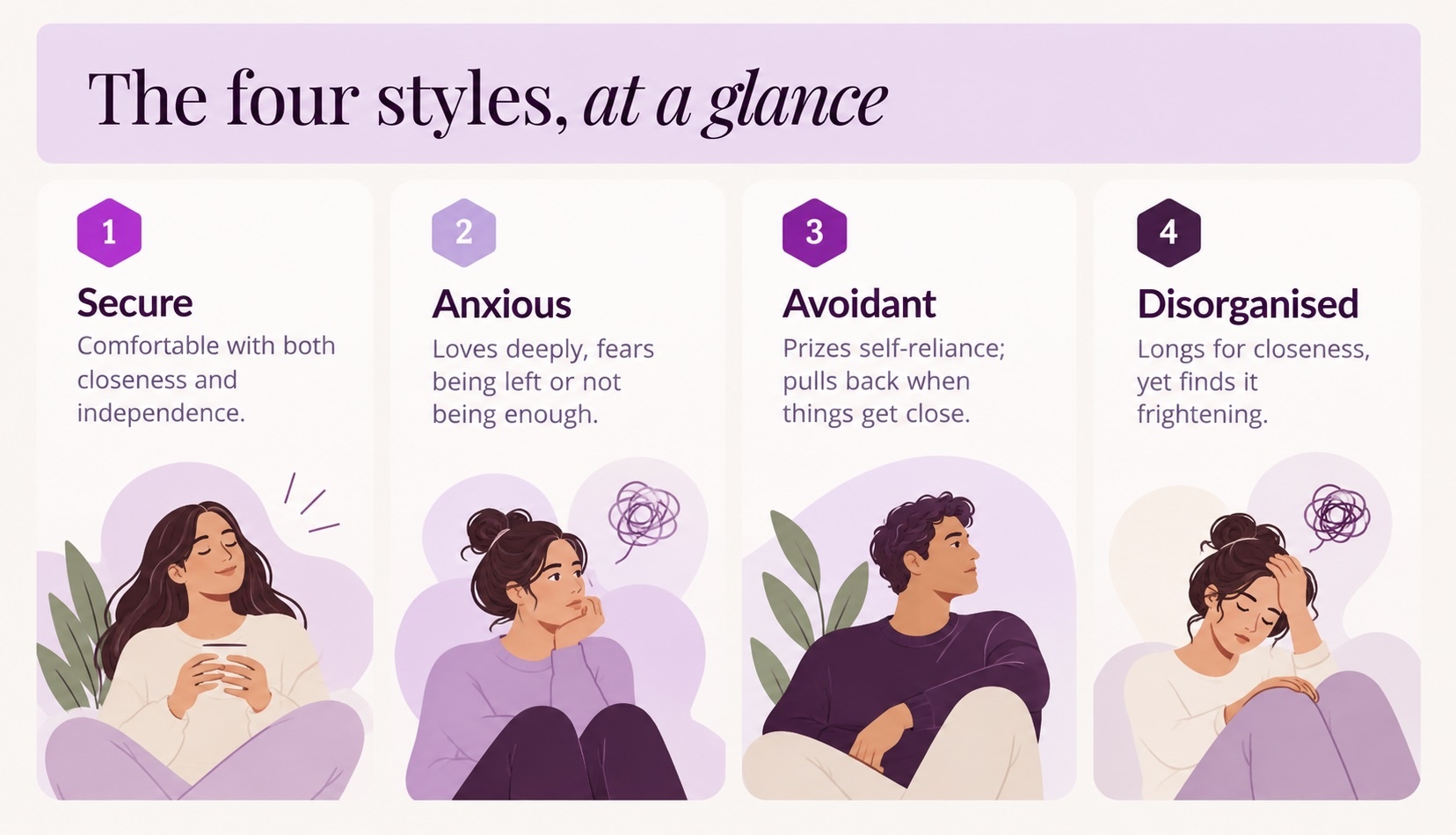
Four attachment styles are commonly discussed: secure, anxious, avoidant and disorganised. What's Your Attachment Style?
What Are the Four Attachment Styles?
1. Secure Attachment
Secure attachment is generally associated with feeling comfortable with both closeness and independence.
If you have a predominantly secure attachment style, you may find it relatively easy to trust other people, communicate your feelings and ask for support when you need it.
That doesn't mean your relationships are always easy or that you never feel anxious. The difference is that difficulties tend to feel manageable rather than threatening the entire relationship.
Secure attachment might look like:
Feeling comfortable depending on other people and allowing them to depend on you
Expressing your feelings and needs without excessive fear
Being able to give someone space without immediately fearing rejection
Managing disagreements without assuming the relationship is over
Trusting people unless there is a genuine reason not to
Feeling worthy of love even when you make mistakes
People with secure attachment can still experience jealousy, insecurity and relationship difficulties. Security is less about having perfect relationships and more about feeling that difficulties can usually be communicated about and repaired.
2. Anxious Attachment
An anxious attachment style can involve wanting a lot of emotional closeness while also worrying about losing it.
You might care very deeply about the people in your life but find yourself particularly sensitive to signs that something could be wrong.
A shorter-than-usual message, a cancelled plan or a subtle change in someone's tone might lead you to wonder whether you've done something wrong.
Anxious attachment might look like:
Frequently worrying that someone you love could leave
Needing reassurance but finding that it doesn't always feel enough
Overthinking messages, conversations, tone or periods of silence
Finding it difficult to relax when something feels "off"
Being particularly sensitive to rejection or distance
Feeling significant relief when someone reassures you that they care
Underneath these behaviours is often a strong desire to feel safe and secure within a relationship.
3. Avoidant Attachment
Avoidant attachment tends to involve a strong preference for independence and self-reliance.
You might be perfectly comfortable supporting other people but find it much harder to rely on someone yourself. When relationships become more emotionally intense, your instinct may be to create distance rather than seek greater closeness.
Avoidant attachment might look like:
Preferring to deal with problems yourself
Finding emotional conversations uncomfortable
Pulling away when someone becomes very close
Finding it difficult to express vulnerability
Valuing your own space, sometimes at the expense of connection
Feeling overwhelmed by other people's emotional needs
Someone pulling away doesn't necessarily mean they don't care. Creating distance can sometimes function as a way of protecting yourself when emotional closeness feels uncomfortable or unsafe.
4. Disorganised Attachment
Disorganised attachment can involve seemingly conflicting feelings about relationships: strongly wanting closeness while also feeling frightened or overwhelmed by it.
You might find yourself reaching for connection and then wanting to escape from it once it arrives. This can create a difficult push-and-pull pattern within relationships.
Disorganised attachment might look like:
Wanting closeness but becoming uncomfortable when you receive it
Pushing someone away and later regretting it
Experiencing relationships as confusing or unpredictable
Struggling to trust people even when there appears to be little reason not to
Finding your own emotional reactions difficult to understand
Moving between seeking reassurance and withdrawing
This pattern can be associated with early experiences in which relationships involved both comfort and fear or unpredictability, making closeness itself feel complicated.
How Do I Know What My Attachment Style Is?
You don't necessarily need a test to begin noticing your attachment patterns.
Instead, think about what tends to happen when a relationship makes you feel vulnerable.
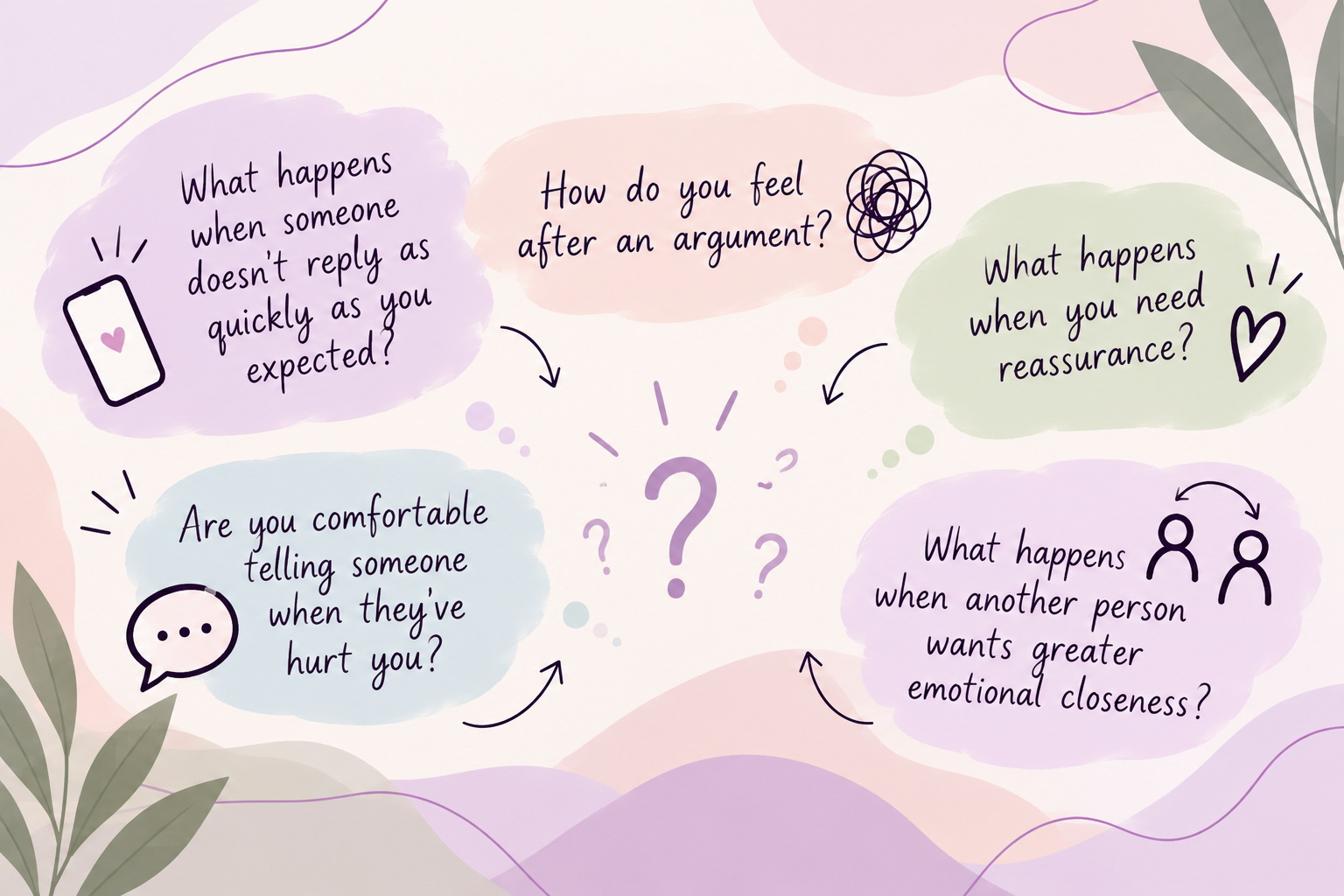
For example, what happens when someone doesn't reply as quickly as you expected? How do you feel after an argument? What happens when you need reassurance? Are you comfortable telling someone when they've hurt you? What happens when another person wants greater emotional closeness?
If you generally feel comfortable with both intimacy and independence, you may recognise more secure patterns.
If uncertainty quickly leads to worry and a need for reassurance, you may recognise anxious patterns.
If your instinct is to withdraw, become more independent or avoid emotional conversations, you may recognise avoidant patterns.
And if you find yourself moving between strongly wanting closeness and feeling frightened or overwhelmed by it, you may recognise elements of disorganised attachment.
Many people won't fit neatly into one category. Attachment can be better understood as a spectrum, and it is completely possible to recognise elements of several styles.
Can Your Attachment Style Change?
Yes. Attachment patterns aren't necessarily fixed for life.
Although some of these responses may have developed early on, our experiences throughout adulthood can also shape the way we relate to other people.
Psychologists sometimes use the term "earned security" to describe developing a more secure way of relating later in life, even when earlier experiences may not have provided that security.
Greater self-awareness, safe and consistent relationships, self-compassion and therapy can all support change.
The goal isn't necessarily to wake up one morning with a completely different attachment style. Change is often much more gradual.
It might mean recognising that you're becoming anxious before immediately seeking reassurance. It could mean telling someone that you need some space rather than disappearing from the conversation. Or it might involve gradually allowing yourself to trust someone rather than assuming closeness will eventually lead to hurt.
Small changes can add up.
How Can You Develop Healthier Relationship Patterns?
Becoming more secure in relationships often starts with awareness.
One helpful approach is to notice your reaction without immediately judging it. You might think, "I'm starting to worry that they're pulling away," or "I can feel myself wanting to shut this conversation down."
Simply recognising the pattern creates an opportunity to decide what you want to do next.
Pausing before reacting can also help. When emotions are heightened, even a short pause can create some distance between what you automatically feel like doing and how you actually want to respond.
It can also be helpful to practise expressing your needs clearly. Instead of expecting another person to work out what you need, you might say, "I'd appreciate some reassurance," or "I need a little space, but I'm not going anywhere."
Finally, try to approach these patterns with curiosity rather than criticism. They may have developed for a reason, and changing long-standing ways of relating usually takes time.
How Can Therapy Help With Attachment?
You don't need to wait until a relationship reaches crisis point to explore attachment in therapy.
Therapy can provide a confidential space to look at recurring patterns in your relationships and understand what might sit underneath them.
Perhaps you repeatedly worry that people are going to leave. Maybe you find yourself withdrawing whenever somebody becomes emotionally close. You might struggle to trust other people, find conflict particularly difficult or notice yourself repeating similar relationship patterns despite wanting things to be different.
Exploring these experiences with a therapist can help you identify triggers, understand your emotional responses and gradually experiment with different ways of communicating and connecting.
Attachment-informed therapeutic approaches can also help people explore how earlier experiences may be influencing relationships in the present.

Understanding Your Attachment Style
Understanding your attachment style isn't about deciding what's "wrong" with you.
It's about becoming curious about the ways you've learned to connect with other people.
You may recognise yourself as predominantly secure, anxious, avoidant or disorganised. You might see yourself across several attachment styles, or notice that different relationships bring out different responses.
Whatever you recognise, your attachment patterns don't have to define your future relationships.
Greater awareness can help you notice when an old pattern is taking over and give you more choice about what happens next.
Healthy relationships aren't about never needing reassurance, never wanting space or communicating perfectly all of the time. They're about developing relationships where it becomes increasingly possible to communicate what you need, tolerate vulnerability, repair difficulties and feel safe being yourself.
At Hive Wellness, we understand that finding the right therapist is an important part of feeling safe enough to explore these experiences. That's why we focus on matching you with a qualified therapist based on your individual needs and preferences, rather than simply asking you to choose someone from a directory.
Whether you want to explore attachment, relationships, anxiety, past experiences or simply understand yourself a little better, therapy can give you the space to start making sense of the patterns that keep appearing.
If you're ready to explore what's happening in your relationships, you can take the first step with Hive Wellness.

Get matched with a trauma specialist
Five minutes now, a match usually within 24 hours.
No pressure, no deadline.
Dr Holly Milmine
DEdPsy, MSc, MA